
Main research lines
ATTENTION-LIKE AND DECISION-MAKING RESPONSES IN INVERTEBRATES
A fundamental step in the processes leading to the emergence of adaptive behavior is the selection of salient stimuli among the infinite variety of external stimuli collected by the organisms sensory system. Attention is the cognitive process of selection of salient stimuli from the environment utilized to generate a suitable behavioral response. An interesting question about attentional processes is whether they act as a filter on the sensory information collected by sensory-centered attention or whether they also play a role in the selection and maintenance of action (action-centered attention), to ignore irrelevant “distracting” stimuli that might elicit alternative motor programs. Attention and decision-making are deeply intertwined cognitive processes where attentional processes influence the evaluation and choice during decision-making.
Attentional and decision-making processes are usually studied in humans and primates. However, more recently, an interest has developed in the study of attention and decision-making also in other vertebrates as well as in invertebrates, in order to discover their neurobiological mechanisms and its role in the evolution of nervous function.
Optomotor response of a tethered fly following a rotating 360° visual stimulus of black and white vertical bars. Fly was suspended in a magnetic field by means of a small pin glued on the thorax. Infrared LEDs (infrared light is not sensed by flies) illuminated the fly and an infrared videocamera recorded at high frequency (200 frame per second or fps) fly movements from below.
SPATIAL NAVIGATION AND SPATIAL MEMORY
Within the endless catalogue of behaviours exhibited by animals, navigational strategies stand out as great candidates for widely spread and shared behaviours among species. Indeed, most living organisms – even those with a sessile final developmental stage – need to navigate through the environment during their lifetime as they search for adequate locations, food and conspecifics while avoiding dangerous situations. At any given time, the individual must keep track of its own position and heading in order to appropriately select the direction to pursue. This process occurs while the individual may or may not have visual contact with its goal and requires the continuous shaping of its behaviour in the presence of ever changing and sometimes contradictory stimuli while filtering the ‘noise’ from irrelevant, redundant or predictable signals. Animals achieve this result by gathering and processing internal and external cues, both global and local, from different sources. Idiothetic cues include proprioception, acceleration sensing and the translational and rotational optic flow (related to the velocity of angular and forward/backward motion). Allothetic cues, on the other hand, may be subdivided into global and local ones; examples of the former include the polarization pattern, the intensity and chromatic gradient resulting from the direct scattering of light in the upper atmosphere, the light from stars and other celestial bodies and Earth’s magnetic field, whereas the latter include visual panorama and landmarks, wind direction and odour plumes and tactile information.
Spatial informations must also be memorized and stored for being utilized in future. This process is fundamental in reducing cognitive charge and energy spent during navigation, being of help in decision-making processing leading to the best behavioral response for the individual.
Random Dots Kinetotogram utilized to study motion perception in fixed tethered flies. Flies were fixed to a micromanipulator by means of a pin glued to the thorax and placed in front of a curved screen on which random dots stimuli are projected using an HD projector. From trial to trial the percentage of dots moving in the same direction is randomly changed from 0 to 100 percent. Dots lifetime is 1s. Although free to fly, flies were not allowed to rotate their body while are still able to move their head to follow visual stimuli (see inset at the base of the video). Fly is illuminated with infrared LEDs. Head movements (corresponding to eye movements in vertebrates) are recorded with an infrared videocamera at high frequency (200 fps). Offline analysis of head movements is done using MATLAB public scripts (M. Raucher, FlyAlyzer https://github.com/michaelrauscher/flyalyzer) or home made MATLAB and R scripts.
Offline analysis of recorded video using MATLAB CrazyFly scripts (B.Cellini, https://github.com/BenCellini/CrazyFly) allowing to measure angular movements in time. Further analyses are done using homemade MATLAB and R scripts.
Infrared video record of a thered fly walking on a ball suspended by a jet of air in order to reduce friction. Flies were fixed to a micromanipulator by means of a pin glued to the thorax. Fly was placed on the suspended ball in front of a curved screen where an optokinetic stimuls is projected using an HD projector. The optokinetic stimulus is a full field visual stimuls made by vertical black and white stripes moving clockwise or anticlockwise at 60°s-1 , which evokes the heading of fly walking in the direction of the visual stimulus. Fly and suspended ball are illuminated by infrared LEDs and their movement are recorded using an infrared videocamera at 200 fps. The movement of the suspended ball is offline transformed in fly walking trajectory using the public program FicTrac (RJ Moore et al, https://github.com/rjdmoore/fictrac) and home made R scripts.
NATURAL REPELLENTS AND MASKING ODOURS IN INSECTS
Odor plumes are extremely important in heading insect during their navigation in the envronment for reaching food, finding mates or hosts. Natural substances masking odours or acting as repellents are produced since the origin of the 400 mya biological war between insects and plants which led, these last, to the production of a variety of different toxins and substances aimed to prevent be damaged. Many of these natural repellents and masking odours are still poor studied or not studied at all and their efficacy is simple the result of on field observation. By using a combination of visuomotor responses and odour plumes, we study the behavioral response of fruitflies to those natural repellents and masking odours. The aim is to identify the specific components reponsible for the observed behavioral effect and analysing their nerobiological activity.
A second, but not last aim, is to identify possible natural alternatives to the use of pesticides which use is no more permitted by UE laws. In particular we want to identify natural repellents and masking odours acting at the periphery of the olfactory system, specifically at the level of odour receptors. In other words, natural compounds which do not interfere with insect nervous system navigation circuits, in order to prevent deleterious effects to pollinators and natural and agricoltural prodcuts obtained as a consequence of their actvities.
These studies are done in collaboration with a private company (Entostudio s.r.l.) and colleagues of the Department of Pharmaceutical Sciences (Prof. Dall’Acqua).
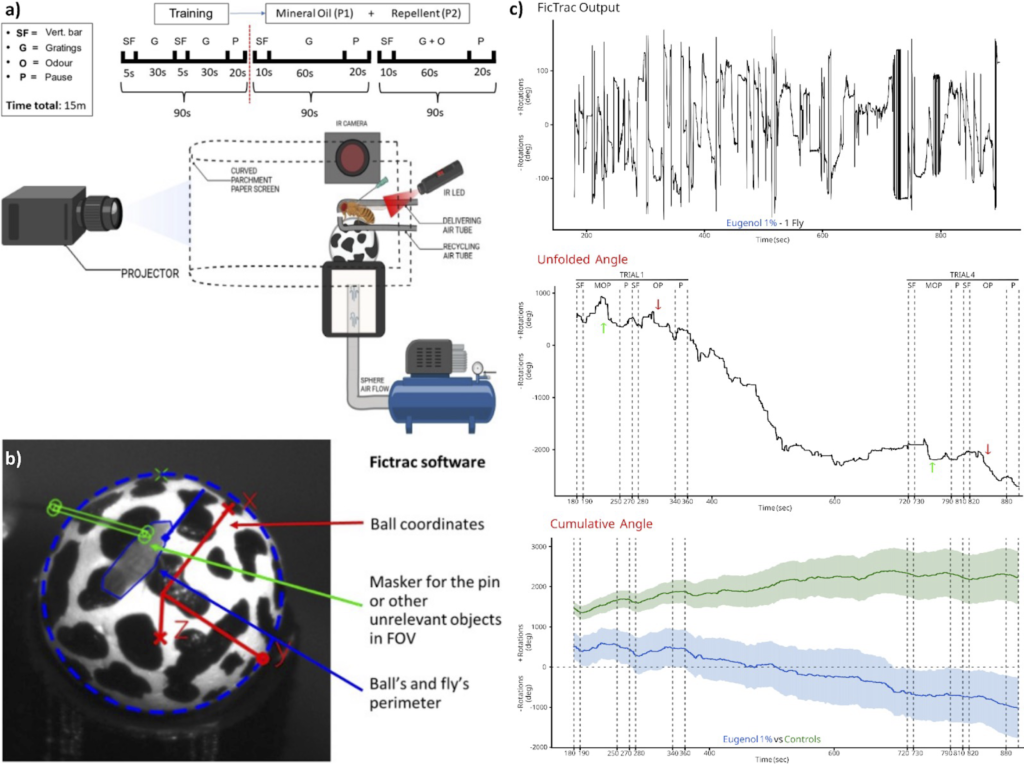
Fly-on-ball setup
(a) Experimental paradigm sequence and cartoon of the experimental apparatus. Created in BioRender. Menti, G. M. (2024) (https://BioRender.com/o07k268.
(b) FicTrac GUI before processing one of our recordings. Blue ROIs identify the limits of the sphere and of the fly. Green ROIs mask object irrelevant or interfering with the tracking. Red arrows set the X, Y, Z axis allowing for the correct extraction of the space coordinates.
(c) In descending order: example of one FicTrac [40] raw output, deconvoluted data, and one sample of the cumulated tracks from Controls (green) and Eugenol 1% (blue) groups (mean ± s.d.). SF: stripe fixation. MOP: mineral oil phase (plain oil + gratings). OP: odorant phase (oil + odorant + gratings; Controls experienced 2 consecutive MOP instead). P: pause (darkness). Note that the training portion (the first part of the paradigm) was excluded from the analysis. Regarding the original versus transformed output from FicTrac [40] calculations: when the limit of ± 3 radians are reached, the coordinate system is flipped to the opposite sign. Inversion points were identified as those points where the first derivative exceeded 2 times the standard deviation.